


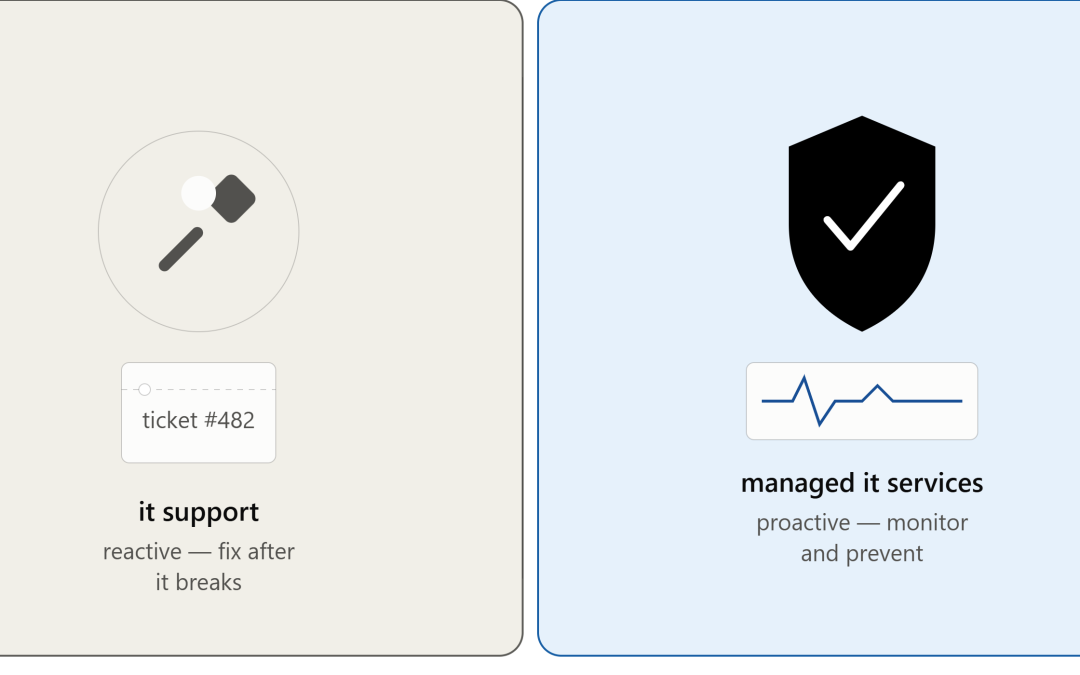
Managed IT services vs. IT support — people use the terms interchangeably, but they’re not the same thing. IT support is reactive help when something breaks — a ticket, a technician, a fix. Managed IT services is an ongoing, proactive partnership where a provider monitors, maintains, and secures your entire technology environment so fewer things break in the first place. Most growing businesses eventually need both, just not necessarily in the same package.
If you’re a small or mid-sized business in London, Ontario trying to figure out which one fits your budget and risk tolerance, here’s the breakdown.
What Is IT Support?
IT support is on-demand technical assistance for a specific problem — a frozen laptop, a printer that won’t connect, a password reset, a software install. It’s typically billed per incident, per hour, or through a basic help-desk plan, and it starts only after something has already gone wrong.
IT support works well for very small teams with simple, low-risk setups where downtime is inconvenient but not existential. It does not include ongoing monitoring, patching, or cybersecurity oversight — you’re paying for someone to show up after the fire starts, not to prevent it.
What Are Managed IT Services?
Managed IT services is a flat-fee, all-in-one partnership where a provider actively monitors, maintains, secures, and manages your network, devices, and software around the clock — catching and fixing problems before they cause downtime, not after.
A managed IT services provider (MSP) typically bundles:
- 24/7 network and device monitoring
- Patch management and software updates
- Cybersecurity tools (antivirus, malware protection, threat detection)
- Data backup and disaster recovery
- Help-desk support (often unlimited)
- Strategic IT planning and budgeting
Because it’s proactive rather than reactive, managed IT services is built for businesses that can’t afford extended downtime or a data breach — which, as networks and compliance requirements grow more complex, is most businesses past a handful of employees.
Managed IT Services vs. IT Support: Side-by-Side
| IT Support | Managed IT Services | |
|---|---|---|
| Model | Reactive — fix issues after they happen | Proactive — monitor and prevent issues |
| Billing | Per incident, hourly, or basic help-desk plan | Flat monthly fee, usually per user or device |
| Monitoring | None or minimal | 24/7 network and endpoint monitoring |
| Cybersecurity | Not typically included | Built in (antivirus, threat detection, patching) |
| Backup & disaster recovery | Rarely included | Standard |
| Best for | Very small teams, simple setups, occasional issues | Growing businesses, regulated industries, remote/hybrid teams |
| Cost predictability | Variable — spikes when things break | Fixed — easier to budget |
Which One Does Your Business Actually Need?
Choose IT support if: you have a handful of employees, one or two devices per person, no sensitive client data, and you can tolerate the occasional half-day of downtime while someone gets to your ticket.
Choose managed IT services if: you have more than roughly 10–15 employees, handle client or patient data, rely on cloud tools like Microsoft 365, operate across multiple locations, or have ever had a “we should really back that up” moment that kept you up at night. According to Made in CA (2025), 92% of Canadian businesses now use public cloud services in some form — and cloud environments need active monitoring, not occasional fixes, to stay secure.
Many businesses start on basic IT support and outgrow it the moment they add a second location, a compliance requirement, or a remote employee. At that point, the reactive model gets expensive fast — one serious outage or breach typically costs more than a year of managed services would have.
How Much Does Each One Cost?
IT support pricing varies widely by provider and incident, which makes it hard to budget around. Managed IT services is typically priced per user or per device per month, which is why businesses that value predictable IT spending tend to move toward it as they grow — you know your IT cost is a fixed line item, not a surprise. See our full range of managed IT packages to compare tiers.
Frequently Asked Questions
Is managed IT services more expensive than IT support?
Not necessarily. IT support looks cheaper per incident, but costs spike unpredictably when something breaks. Managed IT services costs more as a flat monthly fee but is usually cheaper over a year once you factor in prevented downtime, avoided data loss, and built-in cybersecurity tools you’d otherwise have to buy separately.
Can I have both IT support and managed IT services?
Yes — many providers, including Western IT Group, offer tiered managed IT packages (from basic help-desk-style support up through fully managed, 24/7-monitored plans), so you can start where your business is today and move up as you grow.
How do I know if my business has outgrown basic IT support?
Common signs: you’ve had unplanned downtime that cost real money, you handle client or patient data, you’re subject to compliance requirements (PIPEDA, HIPAA, etc.), you have remote or hybrid staff, or your “IT person” is really just whoever’s most comfortable with computers.
Does managed IT services include cybersecurity?
Yes, in most reputable packages. Antivirus, malware protection, and threat monitoring are standard components of managed IT security — they’re rarely included in basic IT support.
What size business needs managed IT services?
There’s no hard cutoff, but businesses with 10+ employees, multiple locations, remote staff, or regulatory obligations typically see the clearest return on switching from reactive IT support to a managed model.
The Bottom Line
IT support fixes things after they break. Managed IT services is built to keep them from breaking in the first place — and to have backups, security, and a plan already in place on the day something does go wrong. If your business is past the “just fix it when it happens” stage, a managed IT services provider is the more defensible long-term choice.
Western IT Group has provided both models to businesses across London, Ontario and Southwestern Ontario for over 20 years, with managed IT packages that scale from basic support up to fully managed, unlimited service. Talk to an IT expert to find out which tier fits where your business is today.